

Most "best email finder" lists rank tools on a single number: how many emails a tool returns. But a returned email is not the same as a deliverable one. A tool can look impressive while quietly filling your list with bad addresses - and bounces are one of the clearest ways to damage cold-email deliverability.
So we measured both: how many contacts each tool found a verified-valid email for (coverage), and how many of those returned emails actually passed independent verification (accuracy). The gap between those two numbers is where outbound campaigns quietly go wrong. This guide compares 14 of the most widely used email finders on the same 5,000 B2B contacts.
The short version: best email finder in 2026 Anymail Finder ran this benchmark and is one of the tools tested, so this is first-party research with a disclosed conflict of interest. To keep it inspectable, every returned email was re-checked by three independent verifiers and the anonymized dataset is public. On the combined coverage-and-accuracy score, Anymail Finder ranked #1 of the 14 tools tested: it found verified-valid emails for 86.4% of contacts at just a 0.9% false-positive rate (98.9% accuracy) - no other tool combined 85%+ coverage with 98%+ accuracy. FullEnrich, a waterfall, edged it on verified coverage (87.1%) but returned false positives more than four times as often (4.0%); Icypeas was marginally more accurate (99.1%) but reached only 49.0% of contacts - little more than half of Anymail Finder's 86.4%. For cold email, where you need both reach and low false-positive risk, Anymail Finder had the strongest coverage-and-accuracy balance in this benchmark.
Best Email Finder Tools Comparison
Here is how all 14 tools ranked on the same 5,000 B2B contacts, scored on coverage and accuracy together:
| Tool | Coverage | False positives | Accuracy | Rank score |
|---|---|---|---|---|
| Anymail Finder | 86.4% | 0.9% | 98.9% | 4 |
| FullEnrich | 87.1% | 4.0% | 95.7% | 5 |
| GetProspect | 71.2% | 3.0% | 96.0% | 6 |
| Findymail | 70.9% | 3.3% | 95.6% | 9 |
| Icypeas | 49.0% | 0.5% | 99.1% | 11 |
| Dropcontact | 69.4% | 5.1% | 93.1% | 11 |
| Apollo | 68.1% | 6.5% | 91.3% | 14 |
| Hunter | 57.6% | 9.3% | 86.1% | 17 |
| Clearout | 60.2% | 15.1% | 79.9% | 17 |
| Prospeo | 45.2% | 3.7% | 92.5% | 20 |
| Skrapp | 49.4% | 17.5% | 73.8% | 22 |
| Snov.io | 46.1% | 15.2% | 75.3% | 23 |
| Voila Norbert | 41.3% | 13.5% | 75.4% | 25 |
| FindThatLead | 45.7% | 23.2% | 66.3% | 26 |
Full results, methodology and the open dataset: Email Finder Benchmark 2026.
Each tool is scored on three metrics:
- Coverage - the share of contacts with a verified-valid email found. The tool found an email and the independent verifiers confirmed it is valid.
- False positives - the share of contacts with an email that failed verification. The tool returned an email, but the independent verifiers rejected it.
- Accuracy - how trustworthy the tool's emails are. Of the emails the tool returned, the percent that passed the independent verifiers.
The Rank score sums each tool's coverage rank and accuracy rank (1 to 14 on each), so lower is better and the tools strong on both rise to the top; ties are broken by accuracy, then coverage. False positives sit outside it and are worth reading on their own - they are the clearest proxy for bounce risk.
The clearest way to see the pattern is to plot coverage against accuracy - the best tools sit in the top-right:
 Anymail FinderCoverage 86.4%Accuracy 98.9%
 FullEnrichCoverage 87.1%Accuracy 95.7%
 GetProspectCoverage 71.2%Accuracy 96%
 FindymailCoverage 70.9%Accuracy 95.6%
 DropcontactCoverage 69.4%Accuracy 93.1%
 ApolloCoverage 68.1%Accuracy 91.3%
 ClearoutCoverage 60.2%Accuracy 79.9%
 HunterCoverage 57.6%Accuracy 86.1%
 SkrappCoverage 49.4%Accuracy 73.8%
 IcypeasCoverage 49%Accuracy 99.1%
 Snov.ioCoverage 46.1%Accuracy 75.3%
 FindThatLeadCoverage 45.7%Accuracy 66.3%
 ProspeoCoverage 45.2%Accuracy 92.5%
 VoilaNorbertCoverage 41.3%Accuracy 75.4%
Each tool plotted by coverage and accuracy - top-right is best, and Anymail Finder is the only tool combining 85%+ coverage with 98%+ accuracy. Hover any logo for its scores.
Which Email Finder Should You Use?
No single tool won every category, so pick by what matters most for your workflow:
| Category | Winner | Result |
|---|---|---|
| Best overall | Anymail Finder | Best combined coverage-and-accuracy score - 86.4% coverage, 98.9% accuracy, 0.9% false positives; no tool beat it on both |
| Highest verified coverage | FullEnrich | 87.1% coverage, but a 4.0% false-positive rate |
| Highest accuracy | Icypeas | 99.1% accuracy, but only 49.0% coverage |
| Best all-in-one database | Apollo | Broad prospecting platform, but verify its emails before sending |
| Best on a budget | Icypeas | Cheapest plan we tested, but a very low find rate (49.0% coverage) |
For most outbound work, Anymail Finder is the best fit, and the reason shifts with the job. Cold outreach lives or dies on bounce rate, and at a 0.9% false-positive rate it was the only high-coverage tool below our 2% editorial threshold - so you reach most of your list without the false positives that damage sender reputation. On large lists, what matters is coverage and cost per usable email: it pairs 86.4% coverage with bulk uploads to 100,000 rows and pay-only-for-valid billing, so you are not paying for the catch-all or unverifiable results other tools bill for. To run lookups inside your own product or CRM, you want results you can send without a second verification step - its API returns pre-verified addresses. And recruiters usually start from a name and a company (often a LinkedIn profile), which is exactly the input this benchmark tested. The closest lighter alternative is Findymail: faster on bulk, but lower verified coverage (70.9%).
How We Tested 14 Email Finders
This guide is built on the original Email Finder Benchmark 2026, published by Anymail Finder. Because Anymail Finder is one of the tools tested, treat the benchmark as first-party research with a disclosed conflict of interest - and inspect the anonymized dataset yourself. The data was collected on June 19, 2026.
- Same 5,000 B2B contacts uploaded to every tool - decision-makers sourced from LinkedIn Sales Navigator across the United States, United Kingdom, France and Germany, at both small and large companies. Junior and entry-level roles were excluded.
- Every returned email independently verified. We did not trust any tool's own "valid" flag. Each returned address was re-checked by three third-party verifiers - BounceBan, ZeroBounce and MillionVerifier - and only counted as valid on a 2-of-3 consensus. Catch-all domains (about 36% of the sample) were adjudicated by BounceBan alone, since the other two verifiers cannot resolve catch-alls. Anymail Finder's own engine never judged any result, including its own. This was not a live-send test - "valid" means an address passed the verifier panel, not that a campaign email was actually delivered.
The Trap: Coverage Without Accuracy
A good email finder has to do two things at once, and it's easy to look impressive on just one of them. A tool can post near-perfect accuracy by only returning the handful of easy, obvious addresses (Icypeas scored 99.1% accuracy but found emails for just 49% of contacts). And a tool can look high on raw "emails returned" while quietly handing you bounces - FindThatLead returned an email for plenty of contacts, but 23.2% of them failed verification.
That's why we rank by coverage measured as verified-valid emails found, then read it next to the false-positive rate. For cold email we treat a 2% false-positive rate as the safety cutoff - our editorial line, not a benchmark output - because mailbox providers like Gmail and Outlook use bounces to flag senders. Only two tools in the whole benchmark returned emails clean enough to clear that bar - Anymail Finder (0.9% false positives) and Icypeas (0.5%) - and Anymail Finder found nearly twice as many of them (86.4% vs 49.0%).
No single tool had both higher verified coverage and higher accuracy than Anymail Finder. So the honest way to compare finders is to read coverage and false positives together, never either one alone. (Anymail Finder verifies emails before returning them, which structurally lowers its false-positive rate).
Do Waterfall Email Finders Find Cleaner Emails?
The one waterfall tool in this benchmark, FullEnrich, queries several paid data sources in sequence to push coverage as high as possible. More sources did mean more reach on the hardest contacts - but it did not mean cleaner data.
FullEnrich edged Anymail Finder on verified coverage by under a point (87.1% vs 86.4%), but its false-positive rate was higher (4.0% vs 0.9%), above the roughly 2% bounce rate generally considered safe for cold email (an editorial threshold we use throughout this guide, not a benchmark output). The tested plan also cost more: FullEnrich was $255 for 5,000 credits versus Anymail Finder's $149 for 5,000, so compare price on the plan you would actually buy rather than assuming a waterfall is worth the premium.
It helps to remember what a waterfall is: not its own finding-and-verification engine, but an orchestrator that resells a stack of third-party providers, querying them in order and returning the first hit. The quality of any given email then depends on which vendor supplied it - and the order those vendors are queried in balances cost against accuracy, since each provider the waterfall calls costs it money. One likely reason more sources didn't mean cleaner data: depending on how a waterfall is configured, it may hand back a source's answer as-is rather than putting every address through its own verification pass.
Where a waterfall genuinely earns its keep is the hardest contacts - the rare ones only one to three tools could find at all. FullEnrich reached 66% of those versus Anymail Finder's 61%; among single-source tools, Apollo was next at 29%. So the honest takeaway isn't "waterfalls are bad" - it's when a waterfall is worth it (rare, hard-to-find lists where coverage trumps everything and you'll re-verify the output) versus when it isn't (most outbound, where the premium may buy more risk than useful reach). We dig into this in the waterfall vs single-source breakdown.
How Do Email Finders Work?
Most email finders follow the same three steps. First, they identify the company's email domain from its name or website. Second, they generate the likely address patterns for a person (first.last@, first@, flast@, and so on) from the name you provide. Third, they check which candidate is real - either against a database of previously seen addresses or with a live verification step. The basic version is an SMTP check that pings the mail server to see whether the mailbox would accept mail; catch-all domains, which accept anything, take more advanced checks to work out whether a specific address actually exists.
The quality differences come almost entirely from that last step. Database-first tools lean on stored data, which is fast but goes stale and misses new hires. It is tempting to assume verification-first tools trade coverage for cleanliness, but this benchmark shows they don't have to: the strongest verification-first tools found more verified-valid emails than the database-first platforms, not fewer, and with far lower false positives. Catch-all domains are the hardest case, and it is exactly where tools diverge: the ones that resolve them rather than flagging them "risky" and giving up are what open up the coverage gap you see in the table above.
How to Choose the Best Email Finder for Cold Email
Four things actually separate the tools:
- Verification vs database breadth. Dedicated finders return fewer, cleaner emails; database-first platforms (Apollo, Hunter, Snov) return more contacts and firmographics but higher false-positive rates.
- Company-name lookup. Hand some tools a company name with no domain and they find almost nothing (Snov and Prospeo here); better ones figure out the domain themselves.
- Catch-all handling. 36% of the contacts sat on catch-all domains; tools that resolve them - instead of flagging them "risky" and stopping - drive much of the coverage gap between the top and bottom of the table.
- Billing. Some charge only for verified emails (Anymail Finder, Findymail, Prospeo); others charge for every result, including unverifiable ones (Hunter, Snov, GetProspect, Voila Norbert), so you pay for addresses that may still bounce.
Deep Dive Reviews: Every Email Finder Tool
Anymail Finder
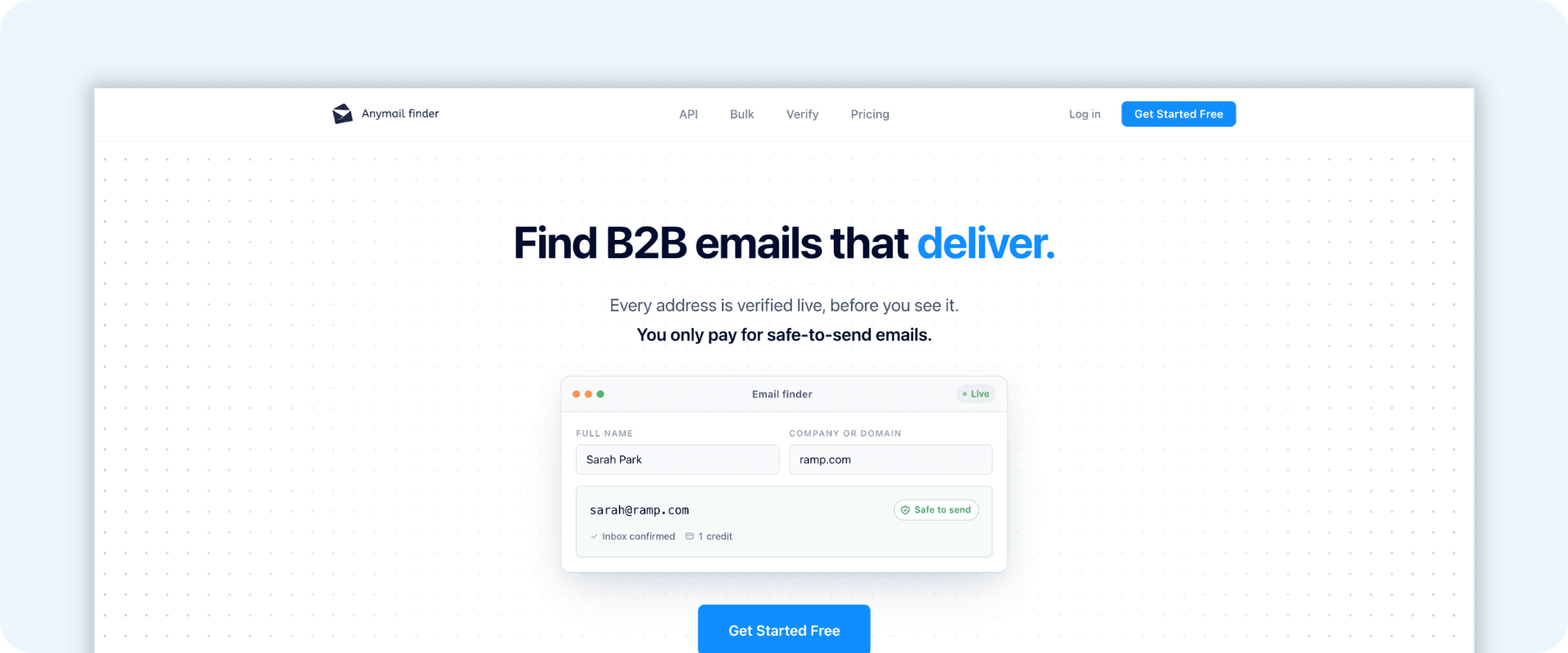
Anymail Finder is a single-source email finder built for outreach at scale - strong bulk workflows, an API, and a verify-before-return model designed to reduce false positives. In the benchmark, Anymail Finder had the best balance of coverage and accuracy of any tool tested: 86.4% verified coverage at a 0.9% false-positive rate (98.9% accuracy), and no tool beat it on both measures.
| Metric | Result |
|---|---|
| Type | Single-source |
| Coverage (verified-valid) | 86.4% |
| False positives | 0.9% |
| Accuracy | 98.9% |
| Bulk speed | ~6 minutes |
| Price (tested plan) | $149 / 5,000 credits |
Where it does well. No tool in the benchmark had both higher verified coverage and higher accuracy than Anymail Finder. It found verified-valid emails for 86.4% of contacts at a 0.9% false-positive rate - the strongest coverage-plus-accuracy result among single-source finders. It also found 53% of the hardest contacts (best of any single-source tool), processed the bulk run in about 6 minutes, resolves catch-all domains, and only charges for valid results. The caveat is important: Anymail Finder verifies before returning emails, which structurally lowers its false-positive rate.
Where it falls short. It isn't a prospecting database - if your main need is list-building with enrichment filters and email finding is secondary, a platform like Apollo or GetProspect fits that shape better.
Use it if you run bulk or API-driven outreach and need a high volume of verified emails with a low false-positive rate. Look elsewhere if you primarily want a contact database to build lists from scratch.
FullEnrich
FullEnrich is a waterfall finder that queries multiple paid sources in sequence to maximize coverage. It had the highest verified coverage in the benchmark (87.1%), but returned false positives more than four times as often as Anymail Finder (4.0% vs 0.9%).
| Metric | Result |
|---|---|
| Type | Waterfall |
| Coverage (verified-valid) | 87.1% |
| False positives | 4.0% |
| Accuracy | 95.7% |
| Bulk speed | ~31 minutes |
| Price (tested plan) | $255 / 5,000 credits |
Where it does well. Its strength is reach: the highest verified coverage in the test and the best hit rate on rare, hard-to-find contacts (62%) - useful if you need the last few percent of a difficult list and can absorb the higher false-positive rate and cost that come with it.
Where it falls short. That coverage edge over a good native finder is under a point, and it comes with a 4.0% false-positive rate (more than four times Anymail Finder's) on a pricier tested plan ($255 vs $149 for 5,000 credits). You'll want to re-verify its output before sending.
Use it if maximum coverage on hard lists matters more than false-positive risk or tested-plan cost. Look elsewhere if you're running standard outbound and need low bounce risk - a native finder can get close to the same reach with fewer false positives.
GetProspect
GetProspect is a lead-generation platform that combines email discovery with a B2B contact database and enrichment data.
| Metric | Result |
|---|---|
| Type | Single-source |
| Coverage (verified-valid) | 71.2% |
| False positives | 3.0% |
| Accuracy | 96.0% |
| Bulk speed | ~52 minutes |
| Price (tested plan) | $99 / 5,000 credits |
Where it does well. Solid coverage (71.2%, best of the single-source tools after Anymail Finder) plus a contact database and enrichment - useful when you want job titles, company details and LinkedIn profiles alongside the email.
Where it falls short. One of the slowest bulk runs in the test, it charges for catch-all and unverifiable results, and a 3.0% false-positive rate means you should verify before sending at scale. During testing the dashboard offered no result summary and one file stalled and needed restarting.
Use it if you want finding plus enrichment in one tool. Look elsewhere if you need maximum verified coverage, fast bulk processing, or pay-for-valid billing.
See the full head-to-head: Anymail Finder vs GetProspect.
Findymail
Findymail is a single-source bulk finder known for fast processing and pay-for-valid billing.
| Metric | Result |
|---|---|
| Type | Single-source |
| Coverage (verified-valid) | 70.9% |
| False positives | 3.3% |
| Accuracy | 95.6% |
| Bulk speed | ~3 minutes |
| Price (tested plan) | $99 / 5,000 credits |
Where it does well. One of the fastest bulk runs we recorded, good coverage (70.9%), pay-for-valid billing, and credit rollover. A clean, no-frills bulk finder.
Where it falls short. Uploads need a single full-name column (not separate first/last fields), so lists often need preprocessing, and the interface processes one file at a time. Coverage and false-positive rate both trail Anymail Finder.
Use it if you run large bulk searches and want results fast at pay-for-valid pricing. Look elsewhere if your lists have separate name fields or you need the highest verified coverage.
See the full head-to-head: Anymail Finder vs Findymail.
Icypeas
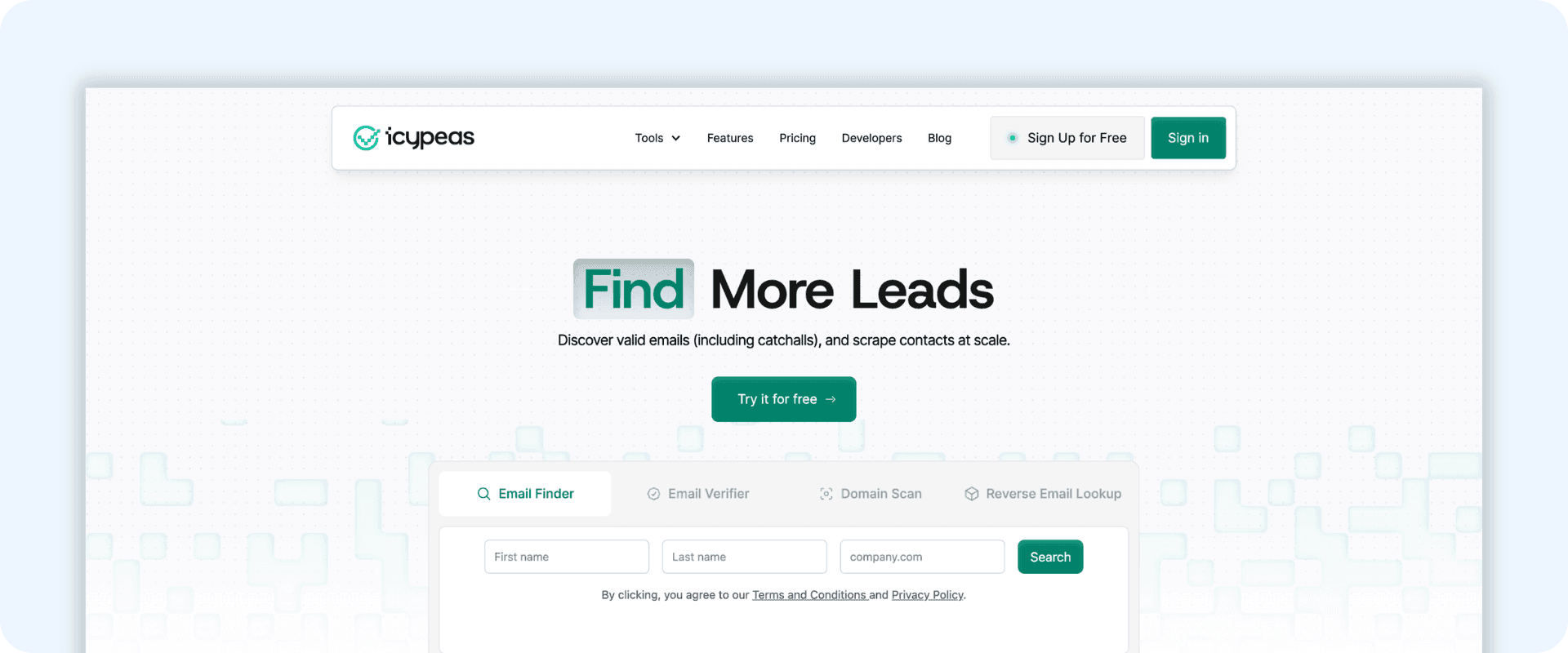
Icypeas is a single-source finder that prioritizes precision over reach - and it shows in the numbers.
| Metric | Result |
|---|---|
| Type | Single-source |
| Coverage (verified-valid) | 49.0% |
| False positives | 0.5% |
| Accuracy | 99.1% |
| Bulk speed | ~8 minutes |
| Price (tested plan) | $39 / 4,000 credits |
Where it does well. Icypeas posted the benchmark's highest accuracy (99.1%) and lowest false-positive rate (0.5%) - though only on the 49.0% of contacts it returned an email for at all. When an address does come back it is very likely to be valid, so it suits low-volume work where you cannot afford a bad send.
Where it falls short. Coverage was only 49.0%, and it found 0% of the hardest contacts. It buys its accuracy by staying conservative.
Use it if you do low-volume, high-stakes outreach where every returned email needs a high chance of being valid and you can accept missing half the list. Look elsewhere if you need to reach most of a list at scale.
See the full head-to-head: Anymail Finder vs Icypeas.

Dropcontact
Dropcontact is a single-source, GDPR-focused enrichment tool with coverage in the middle of the pack.
| Metric | Result |
|---|---|
| Type | Single-source |
| Coverage (verified-valid) | 69.4% |
| False positives | 5.1% |
| Accuracy | 93.1% |
| Bulk speed | ~15 minutes |
| Price (tested plan) | $89 / 4,000 credits |
Where it does well. Dropcontact reached 69.4% verified coverage with a relatively quick bulk run of about 15 minutes, and positions itself around EU/GDPR-compliant enrichment.
Where it falls short. Its 5.1% false-positive rate was above the 2% editorial threshold used in this guide, and it found 9% of the hardest contacts.
Use it if you want a straightforward, EU-focused enrichment option and will verify before sending. Look elsewhere if you need the lowest possible false-positive rate at high coverage.
See the full head-to-head: Anymail Finder vs Dropcontact.
Apollo
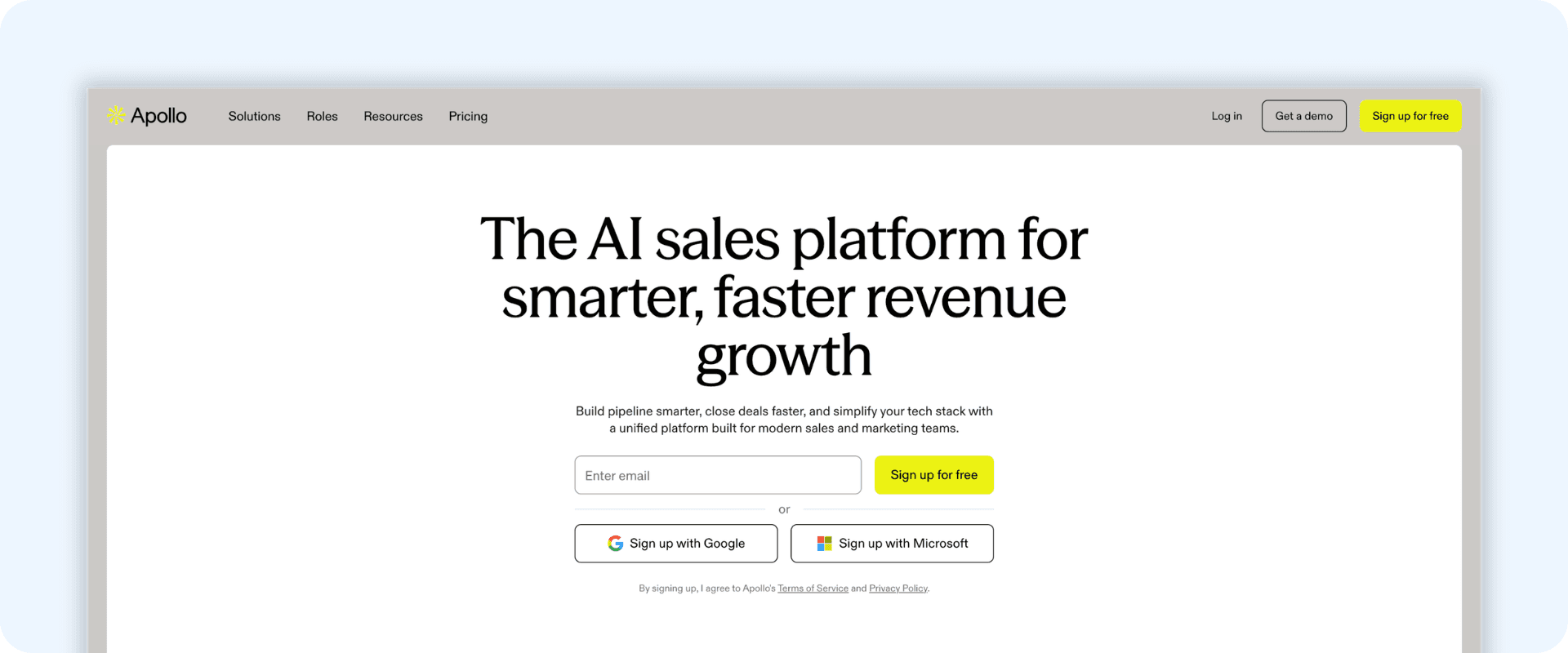
Apollo is an all-in-one sales platform - a large B2B database with prospecting, enrichment, sequencing and email finding built in.
| Metric | Result |
|---|---|
| Type | Single-source |
| Coverage (verified-valid) | 68.1% |
| False positives | 6.5% |
| Accuracy | 91.3% |
| Bulk speed | ~9 minutes |
| Price (tested plan) | $109 / 5,000 credits |
Where it does well. Apollo is the broadest platform in the comparison - prospect database, enrichment, API and outreach in one place - with reasonable coverage (68.1%) and the second-best hardest-contact reach among single-source tools (30%). A strong top-of-funnel prospecting hub.
Where it falls short. A 6.5% false-positive rate is among the higher in the test, so Apollo's emails are best treated as leads to verify, not addresses to send raw. Verification appears secondary to database breadth.
Use it if you want one platform for building lists, enriching and outreach. Look elsewhere if your priority is the cleanest verified email output from a bulk finder.
Hunter.io
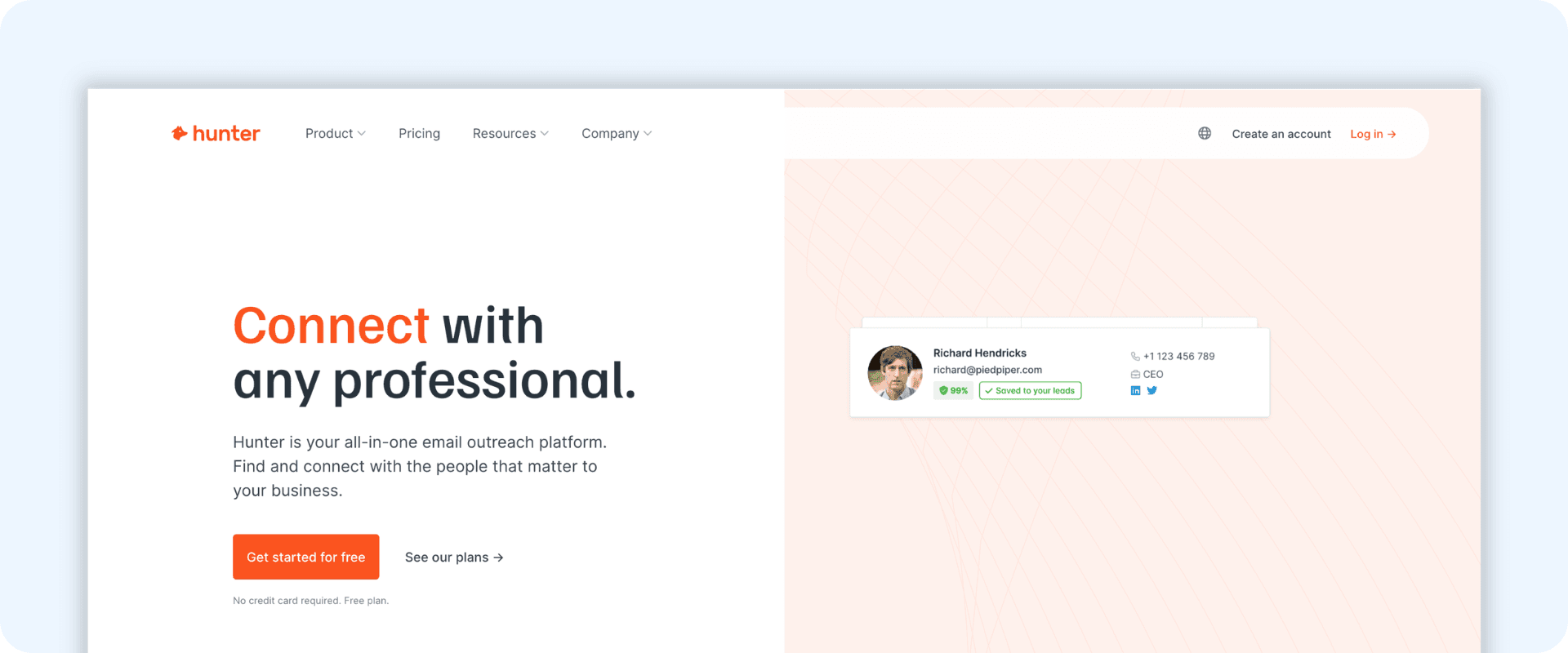
Hunter is a well-known prospecting platform combining email lookup, domain search and a contact database.
| Metric | Result |
|---|---|
| Type | Single-source |
| Coverage (verified-valid) | 57.6% |
| False positives | 9.3% |
| Accuracy | 86.1% |
| Bulk speed | ~54 minutes |
| Price (tested plan) | $149 / 5,000 credits |
Where it does well. A familiar, polished platform with strong domain search - good for finding who's at a company and exploring contacts by domain.
Where it falls short. Middle-of-the-pack coverage (57.6%) and a 9.3% false-positive rate - one of the higher bounce risks here. It charges for every result including catch-alls, and the bulk run was slow (about 54 minutes). It also barely registered on the hardest contacts (1%).
Use it if you value domain search and company-level discovery - a different workflow from the name-and-company bulk matching this benchmark tested. Look elsewhere if you run large bulk lists and need low bounce rates and pay-for-valid billing.
See the full head-to-head: Anymail Finder vs Hunter.

Clearout
Clearout is a verification-first toolkit with email-finding capability, but its finder output in this benchmark carried a high false-positive rate.
| Metric | Result |
|---|---|
| Type | Single-source |
| Coverage (verified-valid) | 60.2% |
| False positives | 15.1% |
| Accuracy | 79.9% |
| Bulk speed | ~141 minutes |
| Price (tested plan) | $130 / 5,000 credits |
Where it does well. Clearout found verified-valid emails for 60.2% of contacts, ahead of Hunter, Skrapp, Icypeas, Snov.io, FindThatLead, Prospeo and Voila Norbert on verified coverage.
Where it falls short. The 15.1% false-positive rate was among the highest in the benchmark, and the bulk run took about 141 minutes.
Use it if you are evaluating it as part of a broader verification workflow. Look elsewhere if you need cold-email-ready finder output without a separate verification pass.

Prospeo
Prospeo is a lightweight finder built around a database lookup rather than live search.
| Metric | Result |
|---|---|
| Type | Single-source |
| Coverage (verified-valid) | 45.2% |
| False positives | 3.7% |
| Accuracy | 92.5% |
| Bulk speed | ~1 minute |
| Price (tested plan) | $99 / 5,000 credits |
Where it does well. A clean, modern interface, pay-for-valid billing, and respectable accuracy (92.5%) on the emails it does return - decent for occasional, simple lookups.
Where it falls short. Low coverage (45.2%) because it leans on a static database rather than live search, and it returned almost nothing on company-name-only inputs. Results were inconsistent across runs in testing.
Use it if you want a simple, low-cost tool for occasional lookups. Look elsewhere if you need strong company-name performance or consistent coverage across large lists.
Skrapp
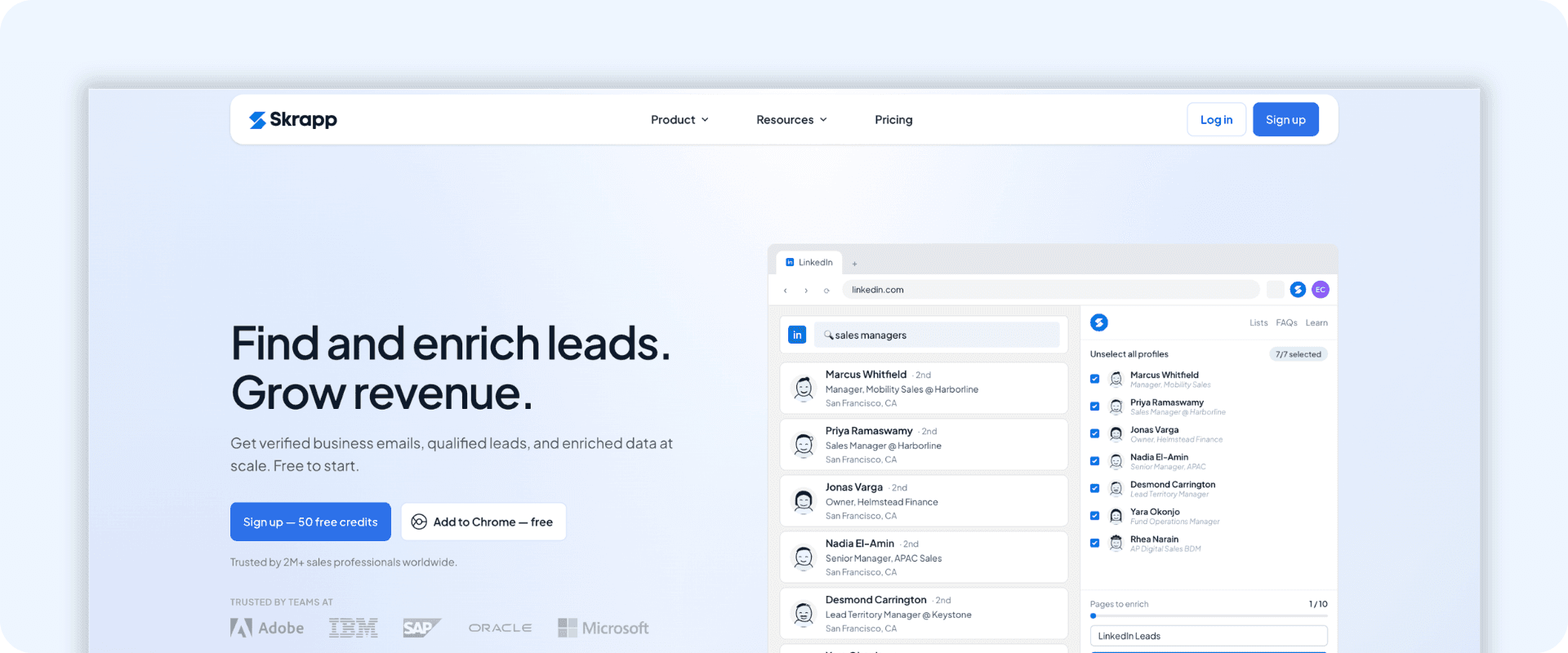
Skrapp is a LinkedIn prospecting tool pairing a Chrome extension with email discovery and basic enrichment.
| Metric | Result |
|---|---|
| Type | Single-source |
| Coverage (verified-valid) | 49.4% |
| False positives | 17.5% |
| Accuracy | 73.8% |
| Bulk speed | ~6 minutes |
| Price (tested plan) | $99 / 5,000 credits |
Where it does well. A handy LinkedIn Chrome extension for capturing contacts while browsing, fast processing, and very high bulk upload limits.
Where it falls short. A 17.5% false-positive rate is one of the worst in the benchmark - roughly one in six returned emails failed independent verification. It charges for catch-alls, and email finding is only one part of a broader product.
Use it if LinkedIn capture is your main workflow and you'll verify before sending. Look elsewhere if you're sending cold email and can't absorb a high bounce rate.
See the full head-to-head: Anymail Finder vs Skrapp.
Snov.io
Snov.io is a sales platform combining email discovery with enrichment and outreach automation.
| Metric | Result |
|---|---|
| Type | Single-source |
| Coverage (verified-valid) | 46.1% |
| False positives | 15.2% |
| Accuracy | 75.3% |
| Bulk speed | ~1 minute |
| Price (tested plan) | $99 / 5,000 credits |
Where it does well. A broad sales suite - enrichment, tech-stack data and outreach automation alongside finding - plus an API. Fast on domain-based inputs.
Where it falls short. Low verified coverage (46.1%) and a 15.2% false-positive rate. It struggled badly on company-name-only inputs (almost nothing returned), and the bulk interface reordered output and made completion hard to track.
Use it if you want a sales-automation platform with finding as an add-on. Look elsewhere if you need verified coverage, low bounce rates, or company-name lookups (common in LinkedIn exports).
See the full head-to-head: Anymail Finder vs Snov.io.
Voila Norbert
Voila Norbert is a long-standing, simple email lookup and verification tool, without broader database or enrichment features.
| Metric | Result |
|---|---|
| Type | Single-source |
| Coverage (verified-valid) | 41.3% |
| False positives | 13.5% |
| Accuracy | 75.4% |
| Bulk speed | ~30 minutes |
| Price (tested plan) | $99 / 5,000 credits |
Where it does well. A straightforward interface for basic lookups and an API for integration - fine for small, simple jobs.
Where it falls short. The lowest coverage in the benchmark (41.3%) and a 13.5% false-positive rate. It charges for all results, limits bulk by file size, and requires emailing support to cancel.
Use it if you need an occasional simple lookup on a small list. Look elsewhere if you need verified coverage at scale or pay-for-valid billing.
FindThatLead
FindThatLead is a prospecting and finding tool. In this benchmark it posted the lowest accuracy and the highest false-positive rate of any tool tested.
| Metric | Result |
|---|---|
| Type | Single-source |
| Coverage (verified-valid) | 45.7% |
| False positives | 23.2% |
| Accuracy | 66.3% |
| Bulk speed | ~455 minutes |
| Price (tested plan) | $99 / month (fair use) |
Where it does well. FindThatLead wraps finding, verifying, prospecting, bulk processing and email sending into one workflow, and its credit model is framed around correct/verified emails rather than failed searches. It may suit teams that want a single lightweight workflow instead of running separate prospecting, finding and sending tools.
Where it falls short. Nearly one in four returned emails (23.2%) failed the verifier panel - the worst false-positive rate and lowest accuracy in the benchmark, and the slowest bulk run by a wide margin. Based on those verifier results, its output should be re-verified before any cold-email campaign.
Use it if you treat it as a raw research source and always verify before sending. Look elsewhere if you're running cold email - it had the highest false-positive rate of any tool tested.
Test These Email Finder Results on Your Own List
Benchmarks are useful, but your list quality, countries, industries and source data will all affect results. If your workflow depends on clean, verified email data at scale, the practical next step is to test a small sample of your own list and compare coverage, false positives and cost per usable email.
Anymail Finder is built for that workflow: bulk uploads up to 100,000 rows, an email finder API, catch-all resolution and pay-only-for-valid billing. In this benchmark it ranked #1 of the 14 tools on the combined coverage-and-accuracy score, with 86.4% verified coverage and a 0.9% false-positive rate. FullEnrich still edged it on verified coverage, and Icypeas still beat it on accuracy at much lower coverage, so choose based on the trade-off you actually need.
If you're integrating an API directly, see how the top email finder APIs compare on rate limits, pricing and webhook support. If budget is the constraint rather than accuracy, we also compared what six of these tools give you for free.
Get 100 Free CreditsFAQs: Best Email Finder
It depends on how you run outreach. In our benchmark of 14 tools on the same 5,000 B2B contacts, Anymail Finder ranked #1 of 14 on the combined coverage-and-accuracy score - 86.4% verified coverage at a 0.9% false-positive rate - and the only high-coverage tool below the 2% editorial false-positive threshold. One waterfall (FullEnrich) edged it on verified coverage (87.1%) but returned false positives more than four times as often.
Coverage is the share of contacts a tool returns a verified-valid email for. Accuracy is the share of a tool's returned emails that passed independent verification. They're different: a tool can post very high accuracy by only returning a few easy emails (Icypeas hit 99.1% accuracy but found just 49% of contacts), so you have to read them together. We rank by verified coverage and read it next to the false-positive rate.
The false-positive rate - the share of returned emails that fail verification - is the clearest proxy for your bounce risk, and mailbox providers use bounces to flag senders. As an editorial cutoff for cold-email safety we use about 2% - in the benchmark only two tools cleared that bar: Anymail Finder (0.9%) and Icypeas (0.5%).
Not necessarily. The waterfall tool in this benchmark (FullEnrich) queries several paid sources to push coverage highest, and it did reach more of the hardest contacts. But it returned more false positives (4.0%) than the best single-source finder, and cost more on the plan we tested ($255 vs $149 for 5,000 credits). It's worth it for rare, hard-to-find lists, not for standard outbound.
Most email finders search by a person's name and company, identify the email domain, generate likely address patterns, and verify deliverability. Many also support bulk CSV uploads and APIs. Because LinkedIn exports often include a company name but not a domain, tools with strong company-name lookup perform better on that workflow.
Anymail Finder published the benchmark, so yes, there is a conflict of interest. We address it by using the same 5,000 contacts for every tool, re-checking every returned email with three third-party verifiers, never letting Anymail Finder's own engine judge results, disclosing the limitations, and publishing the anonymized dataset for review. FullEnrich still beat Anymail Finder on verified coverage and Icypeas still beat it on accuracy - so the only ranking claim we make is that Anymail Finder tops the combined coverage-and-accuracy score, by being strong on both rather than best at either.
An email finder identifies and verifies a professional email address from a person's name and company, so sales, recruiting and growth teams can build contact lists for outreach. For large lists use a bulk email finder; to only check addresses you already have, use an email verifier; to run lookups inside your own systems, use an email finder API.
An email finder gets you a verified address when you already have a name and company; a B2B database is what you use to build the list of people to contact in the first place. Most teams use both. Several tools in this benchmark (Apollo, Hunter, GetProspect, Snov.io) are really databases with finding added on, which in the results often meant weaker verification and higher false-positive rates.
Update history
- July 2026: Expanded from 8 to 14 email finders, added independent triple-verification of every returned email (BounceBan, ZeroBounce, MillionVerifier), and reported false-positive and accuracy rates alongside coverage. Full methodology, limitations and the anonymized dataset are in the Email Finder Benchmark 2026.
- September 2025: Re-ran the original test on 5,000 fresh B2B contacts.
Anymail Finder ran and published this benchmark and is one of the 14 tools tested. To keep it honest, we used the same contacts for every tool, kept Anymail Finder's own engine out of the scoring, verified every returned email with three independent third-party services, and published the anonymized dataset so anyone can check the results.